Live-Edge Wood Cabinetry in Bozeman, MT | Natural-edge slabs for islands, shelves and vanities, dried and stabilised
We're Custom Cabinets Bozeman MT, and we build live-edge wood cabinetry: islands, bar tops, floating shelves and vanities where the natural edge of the tree is kept. We dry slabs to interior moisture, stabilise cracks with butterfly keys, flatten and finish them, and mount them so they can move without splitting.
Free design consultationTell us about the room. We call back to book a measure.
Live-Edge Wood Cabinetry in and around Bozeman MT
Live-edge wood keeps the natural outline of the tree along one or both edges, and we find it suits Montana homes because it brings the landscape inside. Slabs are also thick, wide and unpredictable, so we dry, flatten, stabilise and mount every one with care.
Live-edge slab specification
- Species
- Walnut most often, also oak, maple and local woods
- Thickness
- Typically 1-1/2 to 2-1/2 inches finished
- Moisture content
- Dried to around 6 to 8 percent
- Mounting
- Slotted fixings or cleats allowing movement
How we prepare a live-edge slab
- Slabs dried to interior moisture before flattening.
- Bark removed and the natural edge cleaned and sealed.
- Checks stabilised with butterfly keys or epoxy.
- Mounting that lets the slab move across its width.
Why live-edge pieces fail
| What goes wrong | Why it happens | What we do about it |
|---|---|---|
| Slab cracks after install | Not dried or fixed too tightly. | Dried slab, slotted fixings. |
| Slab cups | Finish only on the top face. | Finish on every face. |
| Edge flakes | Bark left on. | Bark removed, edge sealed. |
Live-edge uses
Islands
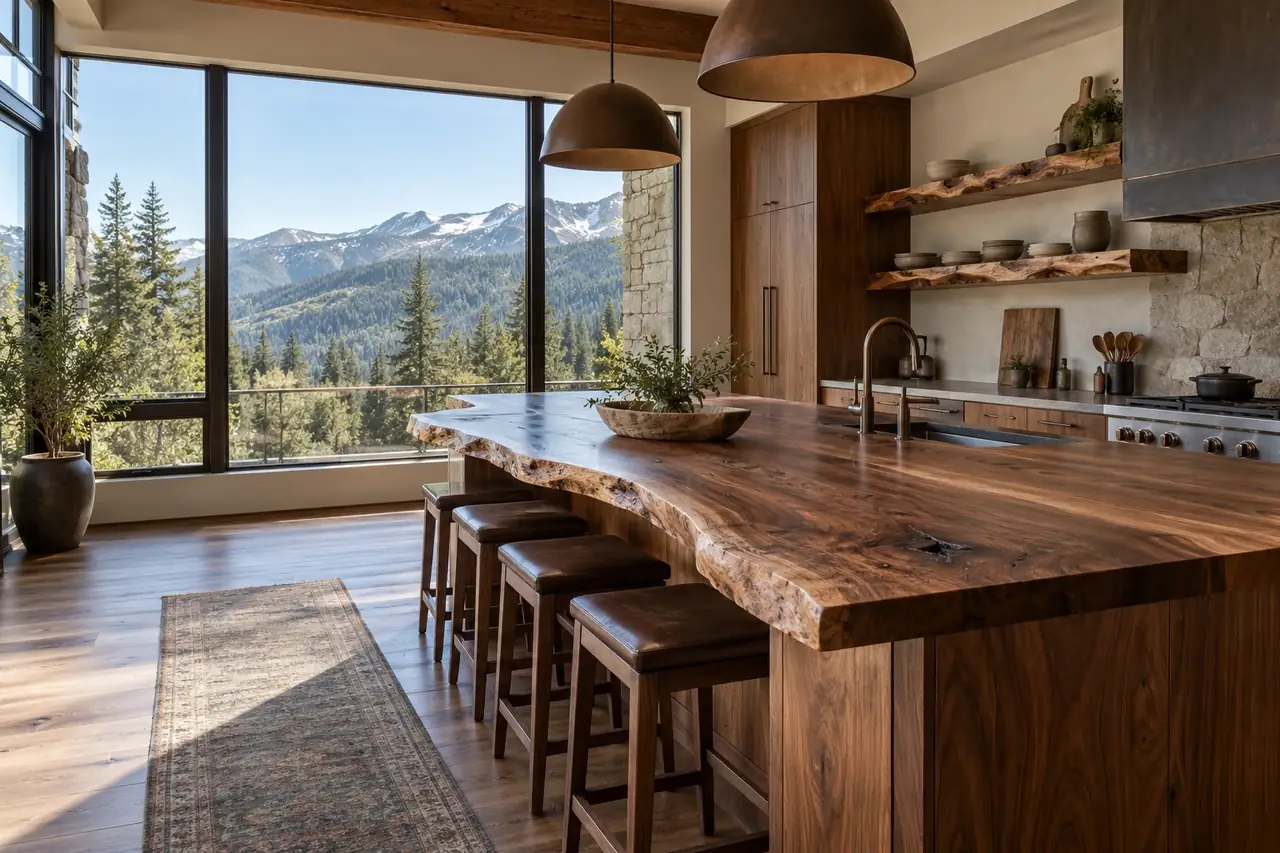
A single slab island top becomes the centre of a kitchen.
Floating shelves
Live-edge shelves on hidden steel brackets suit open kitchens.
Bar tops
A thick slab bar top suits great rooms and basements.
Vanities
A slab vanity top brings warmth to a bathroom.
Butterfly keys and stabilising
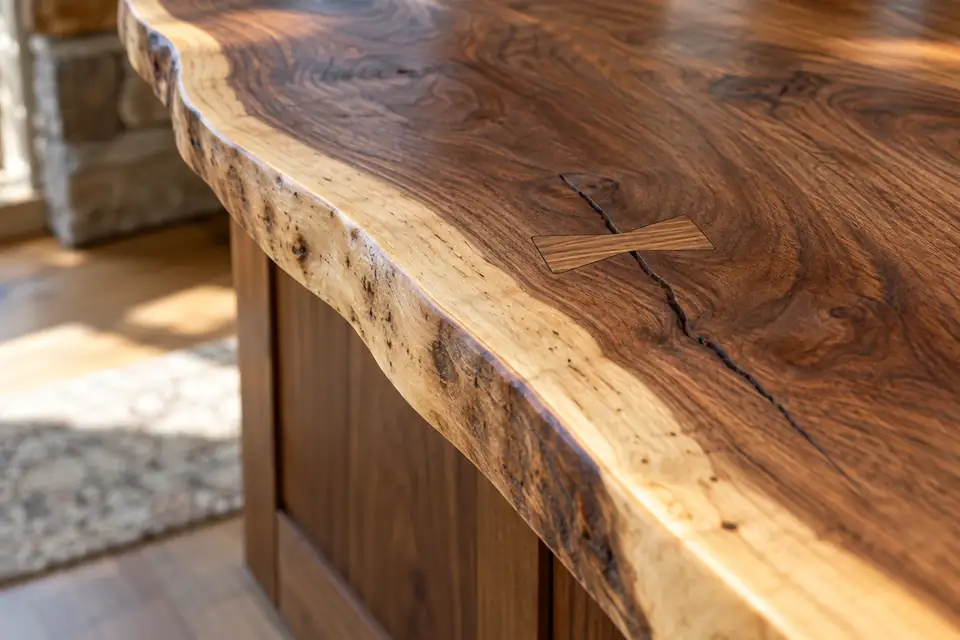
Most slabs have checks, the cracks that open as wood dries. A butterfly key is a bow-tie shaped inlay set across a check to stop it spreading. It is both functional and decorative.
For small voids and knots, we may fill with clear or tinted epoxy. We decide with you how much of the natural character to keep.
From slab to finished piece
Select
You choose a slab by species, shape and figure.
Dry and flatten
The slab is dried and flattened.
Stabilise and finish
Checks are keyed and every face finished.
Mount
The slab is fixed to allow movement.
Rushed live-edge work compared with ours
| The usual approach | How we do it |
|---|---|
| Slab used straight from the mill. | Slab dried to interior moisture first. |
| Bark left on to flake off. | Bark removed and the edge sealed. |
| Slab screwed tight to cabinets. | Slotted fixings that let it move. |
| Checks left to grow. | Butterfly keys across checks. |
Big slabs in dry air
A slab 30 inches wide can move a significant fraction of an inch across its width between summer and winter. In a Bozeman house, where winter humidity drops low, that movement is larger than in many climates.
If a slab is screwed tight to a cabinet, the slab or the cabinet cracks. We use slotted fixings and cleats so it can move freely, and finish every face so moisture moves evenly.
Live-edge and the Montana aesthetic
Live-edge wood fits the mountain aesthetic of Bozeman, Big Sky and the surrounding canyons, where timber, stone and big views set the tone. It is one of the most requested features in new mountain homes.
We keep live-edge pieces as accents rather than filling a whole room, so each one stands out. An island top or a single bar top has more impact than live-edge on every surface.
Local species such as Douglas fir can be used for rustic pieces, while walnut remains the most popular for its colour and stability.
Some clients bring slabs milled from trees on their own property, such as a cottonwood that came down in a storm. Cottonwood is soft and prone to movement, so we assess it carefully and often recommend using it for a shelf or accent rather than a working island top.
Bring your own slab
If you have a slab from a family tree or a local mill, we can often use it. It needs checking for moisture, cracks and insects first.
Freshly cut slabs can take a long time to dry, so plan well ahead.
Live-Edge Wood Cabinetry: terms we use
- Live edge
- The natural outer edge of a tree kept on a board or slab, showing the shape of the trunk.
- Butterfly key
- A bow-tie shaped inlay set across a crack to stop it spreading and add a decorative accent.
- Sapwood
- The lighter outer layer of wood just under the bark. On walnut it creates a pale band along the live edge.
- Slab
- A thick, wide board cut through a log, often with one or both natural edges kept.
Live-edge in bathrooms
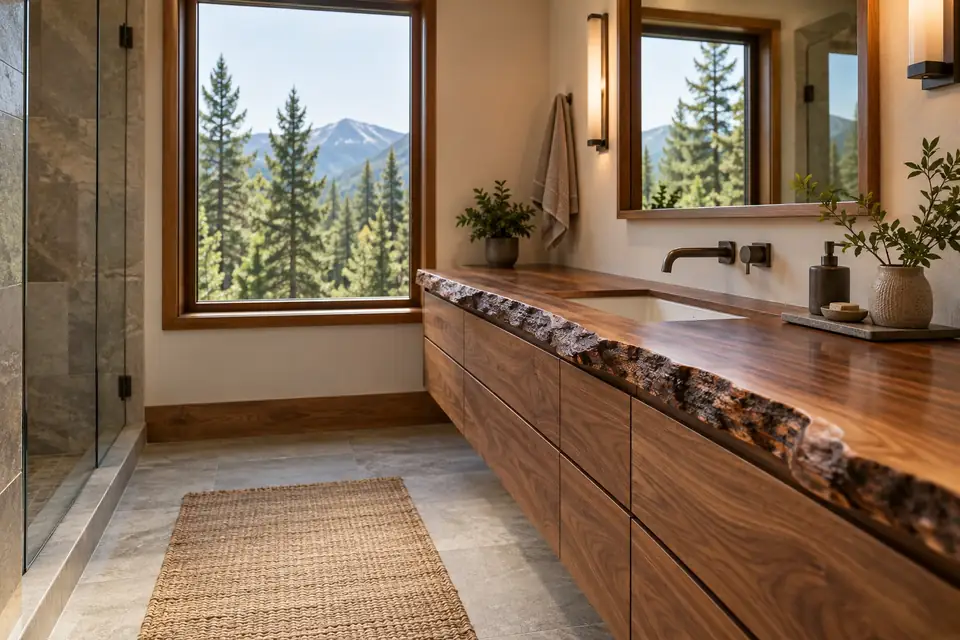
A live-edge walnut vanity top with an undermount sink brings natural warmth to a bathroom. We seal the slab carefully around the sink cutout and on every face, because water is the main risk in a bathroom.
Paired with a simple floating cabinet below, the slab becomes the focal point of the room.
Simple matte black or brass fixtures keep the focus on the grain of the slab.
What drives live-edge cost
Live-edge pieces vary widely. These factors matter most.
Slab size and species
Large walnut slabs are expensive and scarce.
Figure and character
Highly figured slabs cost more.
Stabilising work
Many checks and voids need more keys and epoxy.
Before choosing a slab
- Where the slab will go and its size.
- Species and colour you like.
- How much natural character you want.
- Whether you have your own slab.
Questions about live-edge wood cabinetry
How do you stop a live-edge slab from cracking?
We dry the slab to interior moisture, stabilise existing checks with butterfly keys, finish every face, and mount it with slotted fixings so it can move freely with the seasons.
Does a live-edge bar in a Menard ranch house need a permit?
No. Menard is rural unincorporated Gallatin County under state jurisdiction, and a bar top or cabinetry is finish work with no permit required. A bar sink would need a state plumbing permit pulled by a licensed plumber.
What wood is best for live-edge?
Walnut is the most popular for its colour and stability. Oak, maple and cherry also work well. Local woods can be used for rustic pieces. Walnut also has a dark heartwood and pale sapwood band that make a striking natural edge.
Is live-edge wood durable for kitchen islands?
Yes, with a durable finish. Walnut is softer than stone, so it can dent, but it can also be refinished. Small dents can be steamed or sanded out, and the finish can be renewed without replacing the slab.
What is a butterfly key?
A bow-tie shaped inlay set across a crack to stop it spreading. It is both structural and decorative. Keys are usually made from a contrasting wood so they read as a deliberate feature.
Can I use a slab from my own tree?
Often yes, but fresh slabs take time to dry. We check moisture, cracks and insects before using it. A slab needs roughly a year per inch of thickness to air dry, or less with kiln drying, so fresh slabs need planning.
Should the bark stay on a live-edge slab?
Usually not. Bark tends to loosen and flake. We remove it and seal the natural edge underneath. Sealing the exposed edge also keeps it from shedding dust or splinters over time.
How is a live-edge island mounted?
We fix it with slotted fixings or cleats so it can move across its width, and support long overhangs with hidden steel. Steel supports can be hidden inside the cabinet or recessed into the underside of the slab.
Can live-edge be used in a bathroom?
Yes, with careful sealing around the sink and on every face. We also finish the underside of the slab so moisture from the sink cannot enter from below.
How thick should a live-edge top be?
Typically 1-1/2 to 2-1/2 inches finished. Thicker slabs look substantial but are heavier. Thinner slabs work well for floating shelves, where weight on the brackets matters.
Work that pairs with live-edge wood cabinetry
Live-edge pieces sit within larger projects. These services often go with them.
- Rustic & Reclaimed Wood Cabinets
- Hardwood Cabinetry
- Kitchen Cabinets
- Bar & Wet Bar Cabinetry
- Bathroom Vanity Cabinets
- Solid Wood Cabinets
The tree left as it grew, built to last indoorsNatural-edge slabs for islands, shelves, bar tops and vanities.
Call 406-521-7523